
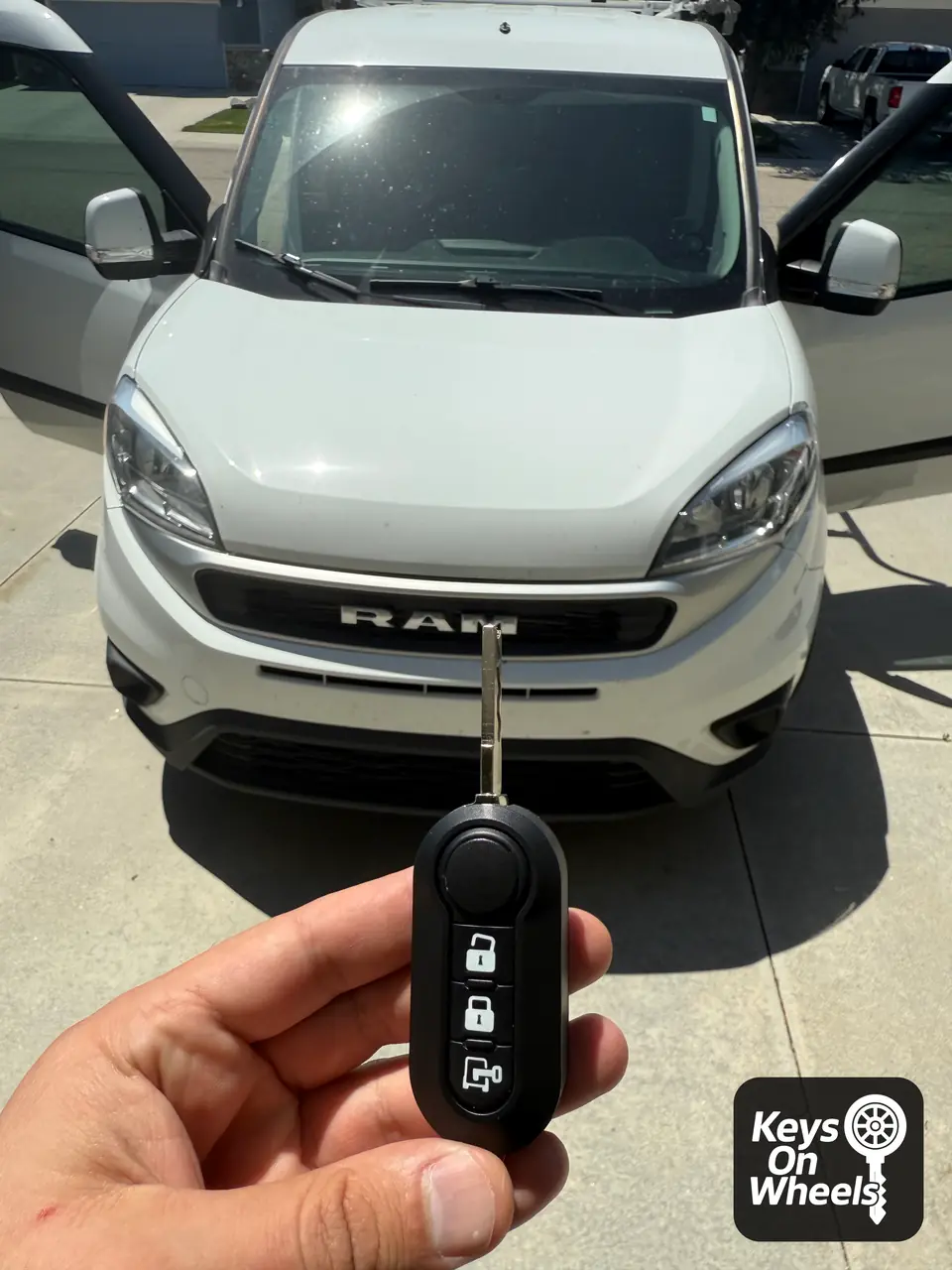
Can you replace a flip key without towing the car?
Yes. A flip key has three parts that all have to be right: the metal blade, the remote buttons, and a chip that the engine computer checks before it lets the car run. Your locksmith cuts the blade on the key cutting machine in the service vehicle, then uses programming tools to register the chip and the remote with your car. Both happen wherever the car is parked, from a Meridian driveway to a lot in Downtown Boise, and the key is tried in the door, the ignition and on each button before we go.
That covers a spare, a replacement for a broken one, and a car with no working key left, which our all keys lost page explains.
Flip key or remote-head key?
People mix these two up, and it changes which key we bring. A flip key, sometimes called a switchblade key, has its blade on a hinge: press the button and it swings out, fold it back and it tucks into the remote. A remote-head key has a fixed blade that never folds, with the buttons molded into the head.
You'll find flip keys on many Volkswagen, Hyundai and Kia models and on plenty of newer Chevrolet and GMC vehicles. If your blade doesn't move, go to the remote-head key page. Push-button car? See push-to-start smart keys.
Where flip keys usually fail
- The spring or pivot pin wears out. The blade flops loose or won't lock open, which makes it risky to turn in the ignition.
- The case cracks around the hinge or the key-ring loop, and small parts start falling out.
- Buttons go soft or quit responding after a long life in a pocket.
- The battery runs low, so the remote only works up close while the blade still starts the car.
Take a loose blade seriously. A key that wobbles in the ignition can bend or snap, and then the visit turns into a broken key extraction plus a new key.
What you can safely try yourself
If only the remote range is fading, replace the coin battery first. Our key fob battery guide shows how, and most flip keys open at a seam along the side of the head.
Replacement flip key shells are sold online, and some people move the circuit board over on their own. Be careful: on many flip keys the immobilizer chip is a tiny separate piece sitting in the old shell, not on the board. Leave it behind and the remote may lock the doors while the engine refuses to start. If that happened, keep the old shell and call us.
Before you call, and when we get there
Tell us what you drive (year, make, model), its location, and whether one flip key still works. If it does, keep it with you at the car, since on some vehicles every key gets registered again during programming. We explain the price over the phone before we drive out.
At the car, your locksmith checks a photo ID along with the title or registration. The blade is cut, the chip and remote are programmed, and the key gets its full test. If something else turns up, like a badly worn ignition cylinder, you hear about it and the new price before any extra work starts.